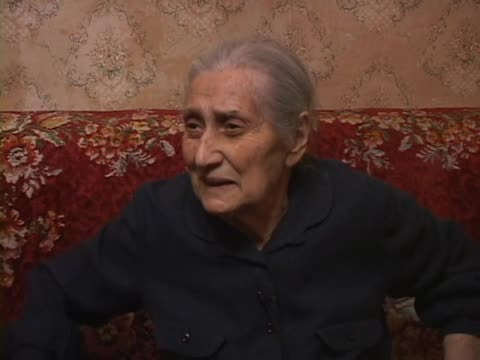
Shmid provides personal information and speaks about her family. Shmid's father was also born in Onitskan Orgeyev and her mother was born in Chişinău. Her father worked in agriculture.
From the machine transcript
Katz opens the recording and asks Shmid her Yiddish name, her date of birth (March 1917) and her parents' origins. Her father was from Onitskan and her mother, Feige, from Chișinău. She says her father worked the land, apparently in gardening or market-gardening.
Gives her date of birth and her mother's name.
Shmid discusses her childhood memories of Onitskan. She describes the children's religious education and recalls prayer customs.
From the machine transcript
Shmid says there was no school or cheder in the village. Her father worked hard so the children could learn Yiddish, pray and put on tefillin. Her family was religious and her father prayed. Katz prompts her to recall the morning prayer, and she cannot remember any songs.
Shmid speaks about her siblings. She grew up with two sisters and four brothers.
From the machine transcript
Shmid says there were seven children in the family and, prompted by Katz, names her siblings from the eldest down. The eldest sister, Raye, married and lived in town. She is now the only surviving child.
Shmid speaks about prewar holiday celebration, providing information for each holiday. According to her, the community rented a house and hired a cantor for the High Holidays. Shmid then describes Sabbath food customs, as well as meals for break-fast.
From the machine transcript
Asked about holidays before the war, Shmid recalls a cantor coming for Rosh Hashanah and a rented house used for prayer, as the village had few Jews. She describes Sabbath challah and fish her mother cooked, and the Yom Kippur fast and the meal that broke it. She adds brief memories of Sukkot with a sukkah of straw, Hanukkah money and dreidel, Purim, Passover matzo and Shavuot cheese pastries.
Covers Sukkot, Hanukkah, Purim, Passover and Shavuot in brief.
Shmid talks about prewar life in her home village. She recalls a local who converted to Christianity. Shmid also describes prewar religious life in the village. She explains that religious infrastructure existed in a neighboring village.
From the machine transcript
Shmid answers questions about non-Jews in Onitskan: they did not speak Yiddish, only picked up a little from the children. She mentions a gentile who became Jewish and a Jew who converted for love of a Christian girl, whose name she does not remember. There were no newspapers in the village and no rabbi, only a shochet in another village, and the Jews did not travel to a rebbe.
Adds newspapers and the question of travelling to a rebbe.
Shmid speaks about prewar traditional weddings. She then shares her recipe for gefilte fish and then latkes.
From the machine transcript
Shmid describes traditional weddings with the chuppah, honey cake and brandy, a meal and dancing. At Katz's request she gives recipes for gefilte fish and Passover latkes made with matzo meal, and describes how a cimes is cooked. Katz then starts asking about charms against the evil eye.
Includes a recipe for cimes.
Shmid addresses folk customs and shares a story about averting the evil eye. She then answers questions about cultural terminology.
From the machine transcript
Shmid tries to recall spoken charms against the evil eye and gives a short rhyming formula about a woman going to a field. The interviewers then ask the meaning of terms such as dibbuk and golem. Shmid does not know dibbuk, and the question is repeated with Russian help from S2.
Includes elicitation of the words dibbuk and golem.
Shmid speaks about her life during World War II. She moved to Chişinău after her wedding, before the war. She evacuated with her mother- and father-in-law to Uzbekistan, via a kolkhoz in Russia. Shmid worked for four years in Uzbekistan. She then addresses her family's fate during the war.
From the machine transcript
Shmid describes her wartime experience. She lived in Chișinău after her marriage and fled with her parents-in-law while her husband was drafted. They were taken to a kolkhoz in Russia and then to Uzbekistan, where they worked for several years. Her own parents were left behind in the village and her father fell ill and was hidden by strangers.
Gives the fate of her parents.
Shmid speaks about her life after the war, after she returned to Chişinău. Shmid worked at a hat factory. Shmid's parents died in evacuation and her siblings returned from evacuation. One of her brothers immigrated to America before the war.
From the machine transcript
Shmid says they returned to Chișinău in 1945 (?) and that she worked in a hat factory. Her parents died in evacuation while her siblings returned. She describes a brother who emigrated to America in 1916 on the invitation of an aunt, had a factory in New York and visited the family after the war.
Shmid talks about her family. One of her sisters made aliyah and another sister moved to Germany. She then speaks about her life today. Shmid raised a daughter and her son-in-law Misha lives in the same apartment. She then shows family photographs.
From the machine transcript
Shmid says one sister emigrated to Israel and another to Germany, while other siblings died. She is now alone, living with her son-in-law, whom she praises. She shows photographs of her late husband Aharon and her daughter Polya, who died young, and the interviewers suggest a short rest.
Includes the photographs and the rest break.
Shmid answers dialectological questions from the AHEYM Yiddish linguistic questionnaire.
From the machine transcript
Shmid answers the Yiddish dialectological questionnaire, with S2 putting items in Russian. Items include greetings such as good day and good evening, 'please', 'thank you', 'luck' and 'house'. Further items are colour, adjective and adverb comparisons, building words, a ladder, honest versus pious, a convert and a peasant, and numbers.
Shmid answers dialectological questions from the AHEYM Yiddish linguistic questionnaire.
From the machine transcript
Shmid answers questionnaire items from Kerler and Lemster, with other voices repeating them. The items are sentences to translate and single words: street, road, river, water, shoulder, flower, potato and expressions like 'one and a half years' and 'various things'. They discuss variants such as plural forms and the word for 'mistake'. At the end she is invited to speak freely about her life and mentions her daughter and grandson.
Ends with a turn to her own life: daughter dead, grandson in Israel, son-in-law.
Shmid speaks about her life today, as well as her family.
From the machine transcript
Shmid talks about her life today. After her daughter's death she has not sung, and she is alone all day, with her son-in-law as her only company. She was one of seven children and is the only survivor. A photograph made in Germany shows her grandson at his bar mitzvah. Asked about prewar photographs, she says none survive.
Photographs: a bar mitzvah picture and no prewar ones.
The team concludes the formal part of the interview with Shmid. They continue to chat about life today.
From the machine transcript
The interviewers thank Shmid and close the formal interview, and an informal chat follows. She says she is old and alone with her son-in-law, who lives with her, and the interviewers praise her answers and the good fortune of having him. They talk about housing and prices, America and New York, and the length of the visit. Russian passages and calling a driver occur, and the transcript is garbled in places.
The chat ranges over housing, America and the interviewers' own travels.