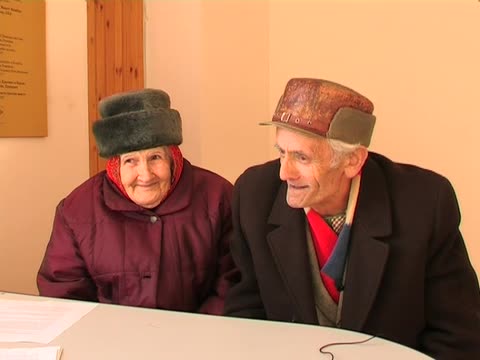
The tape is a formal interview with Meyer Khaimovich Furman, born 1925 in Bălți, and his wife Tsipora Yankelevna Furman, born 1934 in Serbeshty. Meyer provides personal information and talks about his family. His father Chaim was born in Yarmolyntsi*, Ukraine and worked as a contract laborer for leather workers. Meyer grew up with one brother and a sister. After the war, Meyer was a leather worker.
From the machine transcript
Furman answers Lemster's questions about his parents and siblings. His father Chaim came from a place that sounds like Yarmolyntsi and was a shoemaker or leather worker. His mother's name and the grandmother Rachel are mentioned, and he had a brother and a sister who was killed.
Names his mother and grandmother and says his sister was killed.
Meyer discusses his childhood memories and games. In particular, he explains the game with nuts. Meyer celebrated his Bar mitzvah at the Bălți synagogue. He then talks about his education. His parents hired the private tutor Arn Moyshe for his religious education. Meyer attended a Romanian school.
From the machine transcript
Furman recalls childhood games, including a game played with nuts, and his bar mitzvah at the Bălți synagogue, which no longer exists. He did not attend cheder but was taught privately at home by a rebbe (called R' Moshe). He also studied in a Romanian school and not in a Soviet one.
The tutor is a private rebbe, whose name is given as Moshe.
Meyer discusses prewar holiday celebrations, in particular Sabbath. He also mentions food customs and briefly the religious books he read.
From the machine transcript
Furman describes prewar Sabbath observance: no work was done, and the family went to the synagogue. He talks about the food, kugel and the mother's candle-lighting, and mentions a non-Jewish neighbor who lit the stove. He says he read Yiddish, mainly the Pentateuch, and remembers no Sabbath songs.
A non-Jewish neighbor who kindled fire on the Sabbath is mentioned.
Meyer discusses prewar Jewish life and holiday celebrations, including food customs. He then briefly mentions prewar cultural life, in particular a Yiddish theater from Chişinău. When Meyer talks about Sukkot, he explains that they put up sukkah in the hallway of their home.
From the machine transcript
Furman talks about prewar synagogues in Bălți and holiday food: Passover honey cake, Hanukkah latkes, Purim pastries and Shavuot dairy. Lemster asks about Purim plays and a travelling Yiddish theater company from Chișinău. He says the sukkah was built in the hallway of the house, and he also answers about Tisha b'Av and gefilte fish.
Covers Passover, Hanukkah, Shavuot and Tisha b'Av foods as well.
Meyer talks about prewar Jewish life and occupations, as well as mentions non-Jews who spoke Yiddish. Meyer then discusses his profession as a leather worker. He learned and worked with his father before the war. Meyer describes how he made a cap with ear flaps. Meyer briefly addresses prewar cultural and Hasidic life, before he talks about how people went to see the rebbe of Stefanesti with a coachman. Meyer went to see the rebbe of Rîbnita Chaim Zanvil (ben Mosha) Abramowitz after the war. He also remembers postwar Yiddish theater.
From the machine transcript
Furman discusses prewar occupations, Jewish organizations and non-Jews who knew Yiddish. He describes learning the hat-making trade from his father and the parts of a cap with ear flaps. He recalls Yiddish entertainment, Hasidim, and travel to see a rebbe, including the Ștefănești rebbe by coachman. He visited the Rîbnița rebbe after the war.
Includes the terminology of parts of a cap and a Jewish bank and organizations.
Meyer answers questions about cultural terminology, before he recalls prewar Jewish weddings.
From the machine transcript
Furman answers questions about terms and expressions, including a good place for burial and the use of the word Litvak. He explains that Bessarabian Jews were called Romanian Jews. He then talks about attending prewar Jewish weddings, with the groom's procession and klezmer musicians.
Tsipora sings a wedding song she remembers from her childhood, before Meyer continues talking about weddings. Meyer states that people would put up a wedding canopy after the war. Meyer and Tsipora then discuss food customs.
From the machine transcript
Tsipora recites a wedding verse she remembers, and Lemster asks about other songs. They discuss matchmakers, the writing of betrothal contracts and wedding customs. Then they turn to food terms such as kugel, stuffed dishes, sweet and sour dishes, horseradish and rye bread, and whether Jews drank brandy.
Much of it is food terminology questions.
Meyer and Tsipora talk about folk remedies and recall sayings. They recall Chanukah celebrations. Meyer then answers questions about cultural terminology, before he talks about burial and other religious customs.
From the machine transcript
Furman and Tsipora discuss folk remedies and sayings, the evil eye and the use of coals, and Hanukkah customs such as the dreidel. Lemster asks about terms such as dybbuk and golem and about funeral and cemetery customs. They also talk about memorial days, grave visits and blessings for the dead.
Includes the terminology questions and sayings tied to cemetery visits.
Meyer talks about his life during the war. He evacuated near Rostov, Russia, and then to the Samarkand region in Uzbekistan. Meyer was drafted into the Red Army in Uzbekistan and went to different cities in Azerbaijan. Meyer returned to his home town Bălți in 1946.
From the machine transcript
Furman describes the war years: evacuation first to the Rostov region, then to Uzbekistan near Samarkand, where he was mobilized into the Red Army. He served in several places including Azerbaijan, and returned to Bălți in 1946.
Meyer talks about his return to Bălți in 1946 and explains that his house was entirely destroyed. Meyer’s brother-in-law received an apartment through his job and Meyer’s family moved in with him. It happened to be his grandmother’s house. He then discusses Jewish life after the war. According to Meyer, the community reopened the synagogue and it functioned until 1961. After the closure, the community rented an apartment to hold services. Meyer briefly mentions contemporary religious life.
From the machine transcript
Furman says he did not find his house on returning to Bălți, as it had been burned. The family lived in his grandmother's house through the state. He then describes the postwar synagogue, which operated until 1961, and a rented apartment used for services afterward. Today a minyan is still always present.
Notes that the grandmother's house was where the family lived.
The tape is a continuation of a formal interview with Meyer Khaimovich Furman and his wife Tsipora Yankelevna Furman, nee Shtekhman. Tsipora provides personal information and talks about Jewish life in prewar Sîrbesti (Serbeshty) with roughly two hundred Jewish families. Tsipora explains that they set up a Jewish colony there in 1923. Tsipora then talks about her family. Her father, born in Capresti, was a merchant for wood 4:11. She grew up with one sister and three brothers. Her mother was born in Vadul-Rascov.
From the machine transcript
After opening talk about a television broadcast and where the couple live now (Bălți), Furman gives her personal data: her name and the surname Furman, with Shtekhman as her maiden name. She was born in Sîrbești (Serbeshty) in the Sîngerei district, which had about two hundred Jewish families and was a Jewish colony before the war, set up in 1923. She then talks about her family: her father was a merchant, her mother was named Hana, and she names her grandmother and grandfather. She was one of five children, with brothers and sisters including Sender, Esther and Mordkhe.
The father's birthplace and the number of siblings are unclear in the transcript; no sister-and-three-brothers split is clear.
Tsipora talks about her education. She only attended a Romanian/Russian school for two years before the war. After the war, Tsipora completed ten years of schooling and worked as a librarian 7:03. Tsipora discusses her childhood memories and holiday celebrations, in particular Sabbath and Chanukah. Tsipora then recalls Passover celebrations when she danced on the street with the religious teacher (melamed) Berl. Her brother studied with Berl in religious school (cheder). Tsipora maintains that studying with melamed Berl was more expensive than with melamed Hershl.
From the machine transcript
Furman says she finished two classes before the war, one year in Romanian and one in Russian, with no Yiddish, and ten classes after the war, then worked as a librarian. She recalls childhood games and sledding. She describes the Sabbath at home: her mother's candles, the oven-kept cholent and the baked bread. She recalls a spring outing with the melamed Berl, who danced with the children by the river. She explains that her brother studied in Berl's cheder, which cost more than Hershl's. She also describes Hanukkah dreidels, gifts, matzo brought from Capresti, and the turkey fattened in the attic from Purim until Passover.
The catalogue sentence misses the Hanukkah and Passover food customs and the two-language schooling, which the transcript shows.
Tsipora talks about her life before the war. Her family kept geese. She then talks about food customs, including recipes, as well as holiday celebrations. She then describes the Jewish colony in her home village. Tsipora lists the different agricultural products they grew, as well as addresses religious life with Rabbi Chaim Silverman and kosher butcher Hershl. Tsipora and Meyer recall chalutsim (early pioneers to Israel).
From the machine transcript
Furman talks about fattened poultry, holiday dishes, Shavuot food, Purim gift-sending and meat cutlets. She says few non-Jews spoke Yiddish. She describes the colony's farmers working the land, and the crops grown. She names the village rabbi Chaim (surname given as Feinzilber, then Zilberman) and the shoykhet Hershl, neither of whom returned from the war. She and her husband are asked about chalutsim and about collecting money for Palestine. She also talks about the cemetery in Capresti, where her father and grandfathers are buried.
Also covers non-Jewish Yiddish speakers, the Capresti cemetery and a question about theater, not only the colony and chalutsim.
Tsipora provides a recipe for gefilte fish and tzimmes.
From the machine transcript
Furman explains how she prepares gefilte fish: the stuffing, the cooking with potatoes, and the care she takes over the skins. She recalls helping her grandmother with this work. She is then asked for a favorite family recipe and describes beef cutlets with the ingredients and quantities. The passage is mostly fish and cutlets rather than tzimmes.
The passage mostly concerns the fish and beef cutlets; tzimmes is not clearly heard.
Tsipora answers questions about cultural terminology.
From the machine transcript
Furman answers a few questions about customs and terms: a word for the matzo eaten at the end of the seder (?), what is asked for at a holy place, and an expression about speaking at night. The answers are brief and partly unclear.
Tsipora talks about her life during and after World War II. She evacuated to the Rostov province first and then to Kazakhstan. Tsipora then talks about her return home after the war in 1945. They moved into her grandmother’s house. She and her sister continued working in agriculture on fields owned by non-Jews. They owned two hectare land and grew wine. They moved to Bălți in 1949 to live with her uncle and lived there for three months, before building their own house.
From the machine transcript
Furman recalls evacuation to the Rostov region and then Kazakhstan, and the return after the war. The family lived four years in her grandmother's house in the village. She and her sister worked for non-Jewish neighbors for pay and food; the family had had eleven hectares before the war, but took only two afterwards. Lemster asks for the Yiddish and Romanian words for vineyard and grapes. She says the father did not return. She also mentions relatives and a pharmacist in Capresti, and that they moved to Bălți in 1949 to her mother's brother, staying three months before buying and extending a small house.
The transcript also shows the questions about Romanian and Yiddish words for vineyard and grapes, and the pharmacist in Capresti.
Tsipora and Meyer answer dialectological questions from the AHEYM Yiddish questionnaire.
From the machine transcript
Dialectological questionnaire with the couple, led by Lemster with Russian prompts. The items include greetings, 'please', 'thank you', congratulations and 'good luck', and words such as book, window and house. They also cover sour, cold, deaf, kiss, later, faster, near, believer, cross, peasant and mountain, plus short sentences to translate, such as 'he came today', 'in the beginning' and 'my head hurts'. The two informants often answer in turn, and Lemster checks whether both use the same word; the passage ends on where the couple come from.
The Furmans answer dialectological questions from the AHEYM Yiddish linguistic questionnaire.
From the machine transcript
Lemster puts items from the dialectological questionnaire to the Furmans, often prompting in Russian. Items include bed, garden and small tree, vodka, 'in three days they will come', numerals, names for family and relatives, street and river words, parts of the body and clothing, flowers, the shop, a few adverbs and sentence constructions, and a request for proverbs. The Furmans answer in turn; the husband mostly answers and the wife adds corrections.
The wife also answers, and kinship terms, household words and sentence translations are covered.
Tsipora tells anecdotes about Hershl Ostropoler: when he stayed at married couple's house and when he celebrated Passover. She also tells other folk tales. Tsipora then recites a Purim shpiel.
From the machine transcript
Asked for anecdotes, the wife tells several stories about Hershl Ostropoler. In one he tricks a miserly aunt who is cooking for Passover; in another he deceives the community by claiming his wife has died so he can afford Passover. She tells others, one about him as a matchmaker earning kopecks. Lemster then asks for a Purim song, and she recites a short Purim rhyme. The husband says he cannot recall one.
The team concludes the interview with the Furmans.
From the machine transcript
Lemster and the Furmans exchange brief closing remarks as the interview with them ends, with little substantive content.