People › Roza Shmulevna Klein › conversation

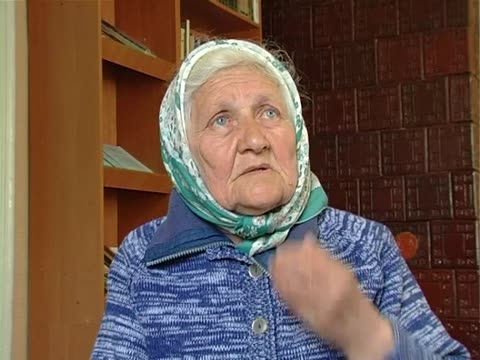
Roza Shmulevna Klein

Starokostyantyniv 27 May 2008 Interviewed by Dov-Ber Kerler, Moisei Lemster 50 min · 1 part on 1 tape
Loading the player…
  1. MDV 675 0:00–50:21 · 50 min · archive.org
Passages

0:00

Cultural terminology.

Questionnaire Cultural terminology MDV 675 · MCO
From the machine transcript

Kerler asks Klein about terms: a street named after Sholem Aleichem, the expressions for a cemetery, and the meaning of the phrase 'a good Jew'. Klein says she only partly knows these, and comments on how they were children before the war and had not thought about what was coming.

Includes a street named after Sholem Aleichem and Klein's remarks on being children before the war.

1:40

Victims of the war.

From the machine transcript

Klein and Kerler speak briefly about the Jews who perished in the war: six million overall and, as people say, around twenty thousand from Starokostyantyniv. She mentions mass graves, some of which are still unknown today. Kerler then turns to ask about gefilte fish.

Mentions the mass graves, some still unknown.

3:04

Food customs.

From the machine transcript

Klein describes how she prepares gefilte fish, which she learned from watching her mother, and says she adds no sugar. Other dishes come up, including borscht (with Russian explanation), pickled cucumbers and tomatoes, and noodle dough for Passover. Kerler also asks for the Yiddish word for tomato; Klein says it was not used and gives Russian/Ukrainian forms.

Covers borscht and other foods and the word for tomato as well as the recipe.

8:59

Informal chat.

Informal MDV 675 · MCO
From the machine transcript

Informal talk at the end of the first interview section about when and where to meet again and the time of day, before Kerler goes on to ask more words.

9:45

Dialectology.

From the machine transcript

Long dialectological questionnaire. Kerler asks for greetings and farewells, the word for 'mouse', house and building words, window glass, 'pigeon', 'closer', breathing, 'sick', and religious terms such as 'to cross oneself', 'convert', 'dybbuk' and 'golem'. Klein answers in Yiddish and Russian, says that her speech and that of the nearby village of Hrytsiv (?) differ (e.g. for father and mother), and gives words for 'money', 'peasant woman', 'bench' and 'grandmother'.

32:09

Explaining AHEYM project.

From the machine transcript

Klein asks in Russian what the recordings are for, and Kerler explains that they will form an archive from which people will learn Yiddish, serving as a catalogue of Yiddish speech of towns like hers.

33:02

Dialectology.

From the machine transcript

Continuation of the dialectological questionnaire. Kerler asks Klein for forms of sentences and words such as river, street, stove, potatoes, 'to put in order', rich man, dreidel, wagon, face, 'many people', 'room' and 'enemy'. Klein, partly in Russian, answers; towards the end Kerler asks how important it is to learn Yiddish, and she hopes Yiddish will not be lost, though she is pessimistic about its future in Ukraine.

Questions put in this conversation

Items of the dialect questionnaire asked here; each link plays the moment.