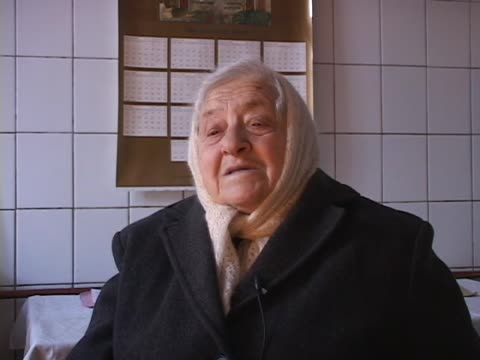
The camera collects footage of the community center.
From the machine transcript
Camera footage at the Soroca Jewish community center, with a few words in Russian and Yiddish among people present about the building and the Jews who remain.
The formal interview with Fanya Magetman, nee Lerner, begins. She provides personal information and talks about her childhood memories of prewar Vadu-Rashkovo. She then talks about her family. Her father owned a mill and a creamery. Her grandfather owned a creamery as well, which is still active today. Magetman grew up with two sisters.
From the machine transcript
The formal interview begins: Magetman gives the date and place, her birthplace Vadu-Rashkovo (forty kilometers from Soroca), her names, maiden name Lerner and Russian name Fanya, and her birth date in November 1927. She describes Vadu-Rashkovo as a Jewish shtetl, and talks about her father, who had a mill and a creamery, her mother, her grandparents (one had a creamery still operating), and her two sisters.
gives her grandparents' names and her sisters' names
Magetman discusses her childhood memories. In particular, she recalls how she and her parents visited the local tzadik. She then talks about her family, in particular her mother, who provided poor people with food on Sabbath.
From the machine transcript
Magetman recalls the Jewish town, which had more Jews than non-Jews, and a visit as a child to a tsadik, as well as a trip with her parents to Chernivtsi. She speaks of her mother's piety and descent, and of how her mother baked bread and gave food and money to poor people before the Sabbath, and held a meal for the poor. She then says her mother was killed in 1941 in the bombing at the start of the war.
adds the trip to Chernivtsi and the mother's death at the start of the war
Magetman talks about her school education and prewar religious life. Specifically, she talks about how her parents attended synagogue services with Rabbi Zukerman. Magetman attended a Romanian school before the war and a Soviet Russian school after the war.
From the machine transcript
Magetman recalls her first year at school and names rabbis in the town, Zukerman among them (the spelling is unclear). She remembers her parents going to synagogue on the High Holidays and a non-Jewish woman who came to light the stove; she cannot name the town's several prayer houses or a tsadik. She attended a Romanian school before the war and a Soviet school after it.
Magetman discusses religious customs at home before the war and her family. She recalls Sabbath celebrations.
From the machine transcript
Answering Katz's questions, Magetman describes her mother blessing the Sabbath candles on Friday and on holidays, and her mother's charity. She recalls Sabbath cakes and challah in a Jewish home, and her grandfather, a man with a white beard who lived in a small house in the courtyard and ate with her mother.
Magetman addresses Yiddish songs and talks about holiday celebrations. According to her, she began to fast at thirteen.
From the machine transcript
Asked about songs before the war, Magetman says she does not sing since her husband died. She recalls Simchat Torah at home and kissing the Torah in the synagogue with her father, and Rosh Hashanah and Yom Kippur. She says she started fasting at thirteen, and still fasts on Yom Kippur.
Magetman talks about her family's life during World War II. Her younger sister and mother were killed during the first bombings on July 8, 1941, according to her. Magetman and her father were injured and then imprisoned in the Chechelnyk ghetto, Vinnytsya district, from 1941 through 1944. Magetman continues that her father and grandmother froze to death on November 28, 1941. Magetman then explains how she lost her fingers in the ghetto, when the prisoners were forced out into the snow on the night of November 28, 1942 . According to her, forty people froze to death that night.
From the machine transcript
Magetman tells how the German bombing at the start of the war killed her mother and younger sister on 8 July 1941, and how she and her father were injured. They were held in the ghetto at Chechelnyk, Vinnytsya region, from July 1941 to March 1944. Her father and his mother froze to death on 28 November 1941, and she lost her fingers and hands that same night, when people were driven out into the snow and forty froze.
the transcript says 1941 for the freezing; the catalogue gives both 1941 and 1942
Magetman talks about German compensation and life today. She worked as a chemistry and biology teacher for 43 years. Magetman then talks about prewar Jewish life, before she returns to discussing life today. She briefly attended the religious school (cheder).
From the machine transcript
Magetman says she receives German compensation, amounting to little, and no pension, since she worked for 43 years as a chemistry teacher. She mentions briefly attending a cheder as a child, remembering nothing of prayer, and compares what she receives with sums paid elsewhere and the cost of living.
adds the discussion of compensation amounts and comparison of living costs abroad
Magetman answers questions about cultural terminology. She then addresses folk customs and describes how to avert the evil eye. Magetman also recalls a local healer from her childhood.
From the machine transcript
Magetman answers questions about the meanings of dybbuk, golem and related terms, saying a golem is a bad non-Jew who did not help Jews during the war. She then recites the verbal charm she used against the evil eye for her grandchildren, with spitting three times, and describes a local woman healer, Brokhe the sprekhern(?).
adds the dybbuk and golem terms and the evil-eye charm
Magetman discusses prewar traditional weddings, she attended with her parents. According to her, the last wedding she attended took place in 1936. She also recalls the local Rashkovsker Klezmer Band.
From the machine transcript
Magetman recalls traditional Jewish weddings she attended with her parents, the last one in 1936. She describes waiting for the bride and groom, the chuppah and the procession, and the klezmer band from Rashkov. She does not remember a badkhn well and does not know the dances Katz asks about.
Magetman talks about the local tzadik Moyshe Papolutsar, who was also a kosher butcher after the war. She then answers questions about cultural terminology.
From the machine transcript
Asked about travel to a distant tsadik, Magetman names a local holy man, Moyshe Papovtsan (spelling unclear), a ritual slaughterer who was still living in Soroca after the war. She explains the terms rebbe and rov and the word litvak, which she takes to mean a left-handed person, and does not know the word epikoyres. She declines to sing.
adds the explanation of litvak and rebbe and rov, and her declining to sing
Magetman talks about her life after the war. She returned from the Chechelnyk ghetto with her sister and brother-in-law. She lived with her relatives until her wedding in 1953. She then talks about her family, in particular her husband, as well as life after the war. She raised two sons and worked as a teacher for 38 years in Soroca and additional years in surrounding towns.
From the machine transcript
Magetman returned from the ghetto with her sister and brother-in-law and lived with them until her marriage in 1953. Her husband helped her because of her injured hands and died in 1990; they had two sons and three grandchildren, and she now lives alone and sometimes comes to the Hesed. She taught chemistry and biology for 38 years in Soroca, and in Floreşti, the Rezina district and other places.
Magetman talks about life today and then answers dialectological questions from the AHEYM Yiddish linguistic questionnaire.
From the machine transcript
Magetman says life today is hard, and then answers the dialectological questionnaire, with Russian prompts read out by S2 and help from S3 and Katz. Items include greetings and good wishes, household words, adjectives and adverbs of time and degree, words for illness, believer and pious person, a convert and a non-Jew, peasant, body parts, flowers and potatoes, and sample sentences to translate.
adds the long run of questionnaire items on vocabulary, forms of address and sentences
Magetman answers dialectological questions from the AHEYM Yiddish linguistic questionnaire.
From the machine transcript
Magetman answers dialectological questionnaire items. These cover sentences to translate and the words for attic, vagon and plural forms, dreydl, 'a good person' and the cantor's lectern. She also gives words for a fence, 'face', suddenly and 'enemy'. Katz repeats items and checks her forms, and S3 prompts in Russian.
The team concludes the interview with Magetman. She talks about her family. Her sister lives in Israel.
From the machine transcript
Katz closes the questionnaire and praises Magetman's memory. She declines to tell more but names her family: her father's siblings, of whom one brother, about ninety, lives in Chicago, and her mother's four sisters and brother. Only her sister, in Israel, survives with her children. Katz then announces the date and begins the interview with Plotnik.
Katz's opening of the Plotnik interview at the end