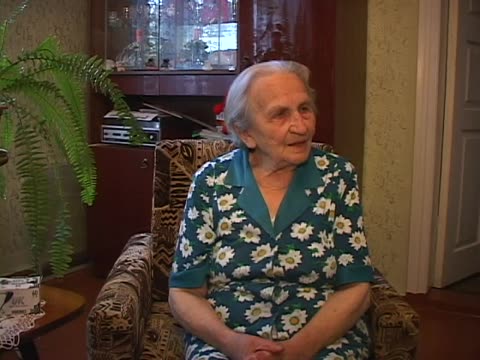
Boiarskaia speaks about the Great Hunger in 1933, when she left Ţîbuleuca and moved to Rîbniţa.
From the machine transcript
Boiarskaia speaks about the great famine of 1933. Young people left the village to look for work, while her parents stayed until the war. She says she was herself in a labor camp far from Donetsk.
The transcript mentions her own stay in a labor camp far from Donetsk.
The formal interview with Boiarskaia begins. She provides personal information and talks about her family. She raised a son and a daughter. Her father was born in Ţîbuleuca and her mother in Rezina. Boiarskaia grew up with two sisters and three brothers, although her mother gave birth to nine children, she explains. Boiarskaia describes how her brother, who was the head of a local collective farm (kolkhoz), was shot during Stalinist repression in 1937. Her father was a worker at a local mill. One of her sisters lives in America.
From the machine transcript
The formal interview begins with the date and her Yiddish names. She gives her birth year as 1919 and tells of her son in St Petersburg, her daughter and her grandchildren. She names her parents' eight children and her siblings: brothers Mekhl, Yidl and Yankl, and sisters Brokhe and Golde. A brother was shot in the 1937–38 repression. Her father was a village laborer, her mother a housewife, one sister lives in New York, and her paternal grandfather Sender Moyshe died aged 96. Her relatives' ages and death years are only partly clear.
Gives the names of the siblings and the grandfather, and mentions the visit to Dobasari the day before where relatives were killed.
Boiarskaia addresses her childhood memories, including her observant home. She states that her father had a Torah ark at home. According to her, five Jewish families lived in Ţîbuleuca and her father held secret services. Boiarskaia then explains how local Jews would join the neighboring community near Goian (former Jewish town Yergolik 11:15, Yiddish: Irnik) to celebrate holidays.
From the machine transcript
Boiarskaia recalls her childhood home, where her father kept a Torah ark, a Torah scroll and a Megillah, and prayed early in the morning in secret. The few Jewish households of the village gathered at their house. On holidays they walked to the nearby Jewish townlet by the Goian road, which had two synagogues and a slaughterer and has since vanished without a trace. Her recollection of the name of the townlet is repeated by Kerler (Yergolik/Irnik).
Adds the secret prayer at home and the walk on foot to the neighboring townlet's synagogues.
Boiarskaia speaks about traditional weddings and the synagogue closing before the war. She then talks about prewar holiday celebration, including Passover and Purim. Boiarskaia baked matzo for her children.
From the machine transcript
Boiarskaia says the synagogues in the area were closed and people feared even to mention them, but her father kept up Jewish observance until the war. She recalls the seder led by her grandfather and then her father, the Passover dishes and the separate chest in the attic, and Purim treats. She explains that she baked matzo herself in her own oven for her children.
Adds Passover seder details and Purim customs, with a brief wedding recollection and talk of her granddaughter's stay in Israel.
Boiarskaia speaks about her family. Her father owned land and animals during the prewar Soviet period. She then speaks about her childhood home. Boiarskaia states that her parents stopped eating meat in the late 1930s, when local communal structures were signifcantly affected by Stalinist repressions. Boiarskaia arranged for parents to move from Ţîbuleuca to Rîbniţa one year before the war broke out.
From the machine transcript
Boiarskaia says her father was born in the village and, after the Soviets came, was given land and kept a horse, cow, geese and ducks. She describes the home as one large and two small rooms, poor but with enough food. Her parents stopped eating meat once the synagogues were broken up and there was no slaughterer. A year before the war she moved her parents to Rîbniţa. She mentions the visiting nephew from Israel, whose father was shot in 1938.
Adds the home description and the father's land and livestock, and mentions the nephew visiting from Israel.
Boiarskaia speaks about the Rîbniţa rebbe and his work as kosher butcher. She states that he attended her daughter's wedding and was their next-door neighbor for three years. Boiarskaia then speaks about her family.
From the machine transcript
Boiarskaia talks about the Rîbniţa shoykhet and rebbe, Khaim Zanvl (?), a beloved man who slaughtered for them, came to her daughter's wedding and lived next door for three years. He called fast days, which people who believed in him kept. She cannot recall songs her father sang. She then names where the older siblings settled after they dispersed: Moscow, Rîbniţa and Tiraspol.
Adds the songs question and the dispersal of her siblings.
Boiarskaia addresses food customs, particularly challah. She then explains how her mother koshered meat.
From the machine transcript
Boiarskaia and the interviewers discuss challah and bread baking, including the custom of throwing a piece of dough into the oven and baking at home. She says she knew no Hebrew blessings and that her mother, who was unlettered, kept the traditional women's observances. She then describes how her mother koshered meat, with a braided basket, soaking and salting. Kerler asks what was said at salting and about the evil eye.
Adds questions on blessings and the evil eye, with the mother's lack of learning.
Boiarskaia talks about healing and folk customs. She then speaks about her family and local cemeteries.
From the machine transcript
Boiarskaia describes how an older Jewish woman in the village cured the evil eye, with coals from the oven and onion peel, and how her husband did something with the onion peel. The interviewers say where they were born (Moscow; Edineţ in Bessarabia) and ask the word for cemetery in Yiddish, Romanian and Russian. She describes her grandfather's grave and says her mother, as a kohenet, did not go to the cemetery. She worries that nobody remembers anything any more.
Adds the terminology questions about the word for cemetery and the husband's background in Bucharest.
Boiarskaia speaks about Jewish life, including the local mohel, in the region before the war, as well as the Rîbniţa rebbe.
From the machine transcript
Boiarskaia speaks about Jewish life in the townlet near Dobasari with a fine synagogue, rabbi and shoykhet, and about the rebbe Khaim Zanvl, who studied with the Stefaneşti rabbi and died in America at a great age. She says Jewish boys were no longer circumcised publicly out of fear; a mohel was still present in 1928. She says the synagogue was closed in 1938 or so, its warden shot, and the community's children went to the Russian school.
Adds the closing of the synagogue and the shooting of its warden, with the rebbe's death in America.
Boiarskaia mentions her school education at a Moldovan school, before speaking about prewar cultural life.
From the machine transcript
Boiarskaia says she attended a Moldovan school in the village, and that Rîbniţa had a Yiddish school that was closed. Her father taught her brothers at home but not her. She recalls Yiddish books in the house and a Yiddish theater in Moscow that her father visited. Before the war, Yiddish artists still came from Chernivtsi to Rîbniţa.
Adds the home teaching of her brothers and the touring Yiddish artists from Chernivtsi.
Boiarskaia speaks about her life during World War II. Her family was confined to the Vastavka ghetto under Romanian occupation. She then speaks about the Great Hunger in 1932/33.
From the machine transcript
Boiarskaia says she worked in Rîbniţa before the war and was driven out with the others. She describes being taken to a camp on the Bug in Ukraine with Bessarabian rabbis, the Romanians arriving after the Germans, and the ghetto formed from the old Jewish houses. Kerler returns to the 1933 famine in her village, and she says she was fifteen when she came to Rîbniţa; Ukrainians came begging for bread.
The transcript places the ghetto at the Bug (name unclear) and returns to the 1933 hunger.
Boiarskaia speaks about her life during the war, when confined to the Vastavka ghetto. She also addresses religious life during this period.
From the machine transcript
Boiarskaia describes the ghetto, where it was forbidden to leave and there was no water, and where Jews slipped out to fetch water and bread. She tells of the rebbe who prayed alone by day and night, helped by others, and who was helped to reach the Dniester. They fasted and were brought food secretly by acquaintances; for Passover two brothers had matzo baked for him. She says she was there with her three children.
Adds the rebbe's solitary prayer and the Passover matzo in the ghetto.
Boiarskaia speaks about her return to Rîbniţa in 1944. She then speaks about Yiddish literature and postwar religious life, led by the Rîbniţa rebbe.
From the machine transcript
Boiarskaia says her house survived when she returned and was later given back to her; her husband was taken into the army and she was left with three children. She talks about reading Yiddish books, Sholem Aleichem and Hershele Ostropolyer, in her family and with her husband, and about the lack of prayer shawls and tefillin after the war. She tells of the rebbe's small room near the Dniester where Jews went on holidays and for yortsayt.
Adds postwar prayer, the rebbe's room and Yiddish reading.
Boiarskaia mentions how she met her husband during the war. She then addresses occupational structure and political organizations in prewar Ţîbuleuca. Boiarskaia maintains that the family's cow saved them from hunger before the war. Boiarskaia then talks about the relationship between Jews and non-Jews before the war.
From the machine transcript
Boiarskaia says she met her husband, who was from Bucharest, during the war in Rezina. She says the few Jewish families in her village worked fields and gardens, and that their cow, named Rozhane, saved the family from hunger in 1933 while her brother who led the kolkhoz went hungry. She talks about wine-growing, selling wine to Jewish travelers, singing Yiddish songs and Zionist visitors, two widows who kept a goat and sewed, and peaceful relations with Christian neighbors who helped on Sabbath.
Adds how she met her husband, the cow's name, wine making, and the Zionist visitors.
Boiarskaia explains how her mother prepared the cholent. She then shares more dishes, including gefilte fish.
From the machine transcript
Boiarskaia describes how her mother prepared cholent: the oven heated on Friday, the dishes sealed in, and the noodle kugel everyone waited for. Lemster asks about Passover dishes such as kezl, malakekh or pletselekh from potatoes, stuffed derma and goose fat, and she names some terms from Bessarabia. She goes on to the braided challah, her mother's chopped fish with matzo meal and onion, and horseradish, beet borscht and its uses on Passover and Shavuot.
Adds Passover dishes, braided challah and horseradish beyond cholent and gefilte fish.
Boiarskaia speaks about prewar Hanukkah celebrations.
From the machine transcript
Boiarskaia describes how Hanukkah was observed in the village, with a small cut piece of wick or rag lit in oil because there were no candles. Kerler then asks for the Yiddish word for Christmas, which she does not know; the interviewers continue to the next questions.
Boiarskaia answers questions about cultural terminology.
From the machine transcript
Boiarskaia answers questions about the meaning of terms such as dibbuk and golem. She gives the Russian equivalents and the sense of a fool or simpleton. The passage ends with her offering to show the interviewers her house.
Boiarskaia speaks about her life after the war. She was a typesetter for a Moldovan newspaper.
From the machine transcript
Kerler asks about her life after the war, and Boiarskaia says she worked in a printing house in Rîbniţa as a typesetter. The work was for a Moldovan-language newspaper, and the interviewers confirm the Yiddish word for typesetter.
Boiarskaia speaks about a local intellectual, Dr. Yisroel Ayzen, who was also confined to the Vastavka ghetto. She then talks about her life at the beginning of the war, when her family fled Rîbniţa toward Krasni Okny in 1941. Boiarskaia describes how Dr. Ayzen collected valuables from the prisoners and was able to arrange a release. Boiarskaia's family returned to Rîbniţa.
From the machine transcript
Asked whether people sang in the ghetto, Boiarskaia says nobody did, because people were afraid. She tells of a learned man named Yisroel (?), a fellow prisoner who wrote down life in the ghetto on scraps of paper and died after the war. She recounts how her family fled in 1941 toward Krasne (Krasni Okny), where Germans and Romanians seized thousands of people. The learned man collected gold from the prisoners to buy them off; the guards got drunk and the family escaped through the hills and villages back to their town, where a great slaughter was under way. She answers Kerler's questions about who carried out the killings, saying it was the Romanians, with the Germans passing through earlier. The passage ends with Kerler's question about vodka among Jews in her village.
Names Krasni Okny as the place of capture, the buying-off of the guards and the killings in the home town, and says nobody sang.
Boiarskaia speaks about prewar Jewish life and recalls a positive relationship between Jews and non-Jews. She then answers dialectological questions from the AHEYM Yiddish linguistic questionnaire.
From the machine transcript
Boiarskaia first says her father drank little wine in old age, only a little brandy for the Sabbath. Most of the passage is Kerler's questionnaire, in which he gives Russian words and short sentences for her to put into Yiddish. Items include greetings, thanks, house/houses, mouse, belly, colours, adjectives (old, healthy, deaf, mute), time and place adverbs, pronouns, numbers and years, and verbs of speaking, hearing, seeing and coming. Also asked are terms for Christians, convert and field worker, Sabbath-day words, and religious terms such as 'light of paradise' for the dead and cantor and rich man in the synagogue. She says the few Jews in the village lived on good terms with their neighbours, who did not call them 'zhid'. Lemster joins with some suggested forms.
Besides the questionnaire, it shows her remark on her father's drinking and on good neighbourly relations.
The team concludes the interview with Boiarskaia.
From the machine transcript
The interview closes in a brief exchange in which Boiarskaia says she understood the interviewers were writing a book, and Kerler responds.
The camera collects footage of the Rîbniţa synagogue.
From the machine transcript
Camera material in the synagogue (Rîbniţa according to the catalogue; the transcript does not name it) with Kerler and Lemster talking mostly in Russian, with some Yiddish, about the building. They discuss the painted decoration and the ceiling, and who built and painted it; another voice asks a short question. The transcript is fragmentary.